

New USDA guidelines: “Eat Real Food” – But Don’t Outsource Your Judgment
Ah, the new food pyramid…
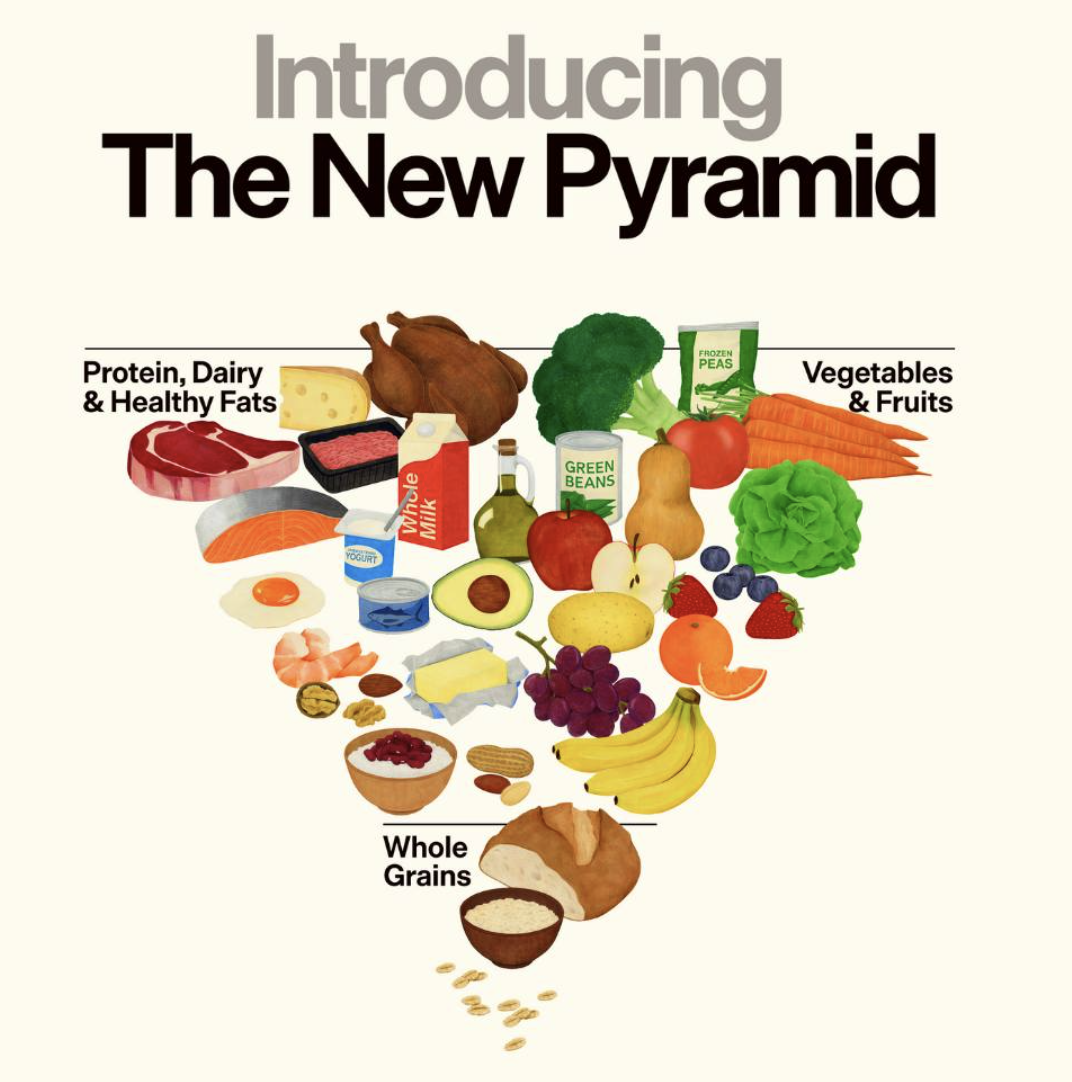
The new USDA food guide - published Jan 2026
Hot off the press, with a catchy - and actually useful - headline message: “Eat real food.”
On the surface, this is a welcome shift from the old abstract “dietary patterns” language to something plain and practical—especially for midlife women (who already struggle enough with knowing what to eat, or not).
The whole thing is better in some ways, and worse/confusing in others.
Effectively, the core advice is familiar and still solid:
• Eat plenty of vegetables and fruits.
• Choose whole grains over refined grains.
• Limit added sugars and excess sodium.
• Cut back on ultra-processed foods high in sugar, salt, and saturated fat.
Where It Gets Messy: Protein, Dairy, and Saturated Fat
The new guidelines significantly increase recommended protein intake and strongly emphasize animal protein and full‑fat dairy.
They increased the recommended daily protein intake from 0.8 grams per kilogram of your bodyweight to 1.2-1.6 grams…
This is a good thing for us midlife women, as adequate protein is crucial for preserving our muscle, supporting our metabolism, and stabilizing our blood sugar.
The nuance here is (a) what types of protein are being recommended, and (b) the typical diet is already low in fruits, vegetables, legumes, and whole grains, so, if people simply “add more meat” and full‑fat dairy without adjusting anything else, two things are likely:
• Total calories go up, making weight gain more likely.
• Protein and saturated fat crowd out fiber-rich plants, which are key for heart, metabolic, and gut health in midlife.
The new inverted pyramid makes this even more confusing:
Visually, it highlights red meat, butter, and full‑fat dairy at the top, yet the written document still tells people to limit saturated fat to under 10% of calories. Hmmm. For perimenopausal and menopausal women, this mixed messaging is risky: saturated fat raises LDL and ApoB for many of us.
The Quiet Hero for Midlife: Fiber
One of the biggest misses in the new guidelines is how little they emphasize fiber.
Fiber is one of the most protective dietary components we have, yet most adults fall far short of recommended intakes.
For midlife women specifically, higher fiber intake is associated with:
Better blood sugar control and improved insulin sensitivity.
Healthier weight & appetite regulation (fun fact: consuming at least 25g fibre/day is associated with less visceral fat accumulation, especially soluble fiber!)
Lower risk of cardiovascular disease & progression of coronary atherosclerosis.
Better gut health and more stable hormones via a healthier microbiome.
All this awesome jazz REALLY matters in a phase of life when heart risk naturally climbs AND our metabolic health takes a big shift towards insulin resistance, higher cholesterol and belly fat accumulation.
So, top picks for fibre are
1. veggies,
2. low glycemic index fruit,
3. seeds and
4. nuts in moderation (a palmful a day generally)
5. Whole grains and legumes (are a distant last place - see below)
I try as much as possible to make at least HALF my plate veggies at every meal, including most breakfasts (which are eggy).
I also LOVE chia and ground flax seeds with nuts, cinnamon and apples or blueberries + protein powder. Psyllium husk is a also super power!
[WARNING: Impending rant on grains]
Whole grains and legumes can be fine, but they’re my last choice for fibre and but my personal recommendation is often to limit them in quantity.
Why?
I’ll be REAL here and offer you an unpopular opinion + a lil’ personal anecdote:
As per the ancestral eating logc, I’m NOT convinced that eating grains and legumes as a dietary staple (AKA in large quantity) is good for most human digestive systems / overall health.
(Especially given the way they’re grown in the modern industrial world, and *especially* in North America.)
Why?
Years ago, I was studying ancestral nutrition and listening to some very convincing nutrition scientists + gut health experts on the matter, I came across some strong arguments against grains as a staple for most people.
(I won’t dive in here but suffice to say, it’s not just about the gluten - it’s the other plant toxins too, and the ways they’re grown. In a nutshell, we’re eating “plant babies” when we eat grains and seeds, and most plants don’t like that so they pack their babies full of plant toxins. Some of these are broken down in the cooking process, but many aren’t. Humans didn’t evolve eating loads of these things either, so our digestion isn’t geared that way either.)
So I decided to play around with my diet as I was having some health issues at the time - recovering from burnout, skin flakiness, wonky energy, some extra chub I wanted gone.
I CUT OUT grains almost entirely (but for a little bit of organic quinoa, but it’s technically a seed).
I did this for MONTHS.
No, it was not easy at first - I really freaking love muffins and sourdough…but I got used to it and it was a no brainer after a few weeks…
And it was partly a no-brainer because I felt SO good!
AMAZING, in fact!!
And SO many things I was struggling with improved - my skin, energy, digestion, constipation, monthly cycles.
I thought, “Woah, this is wild! I’ve been mowing down hard on these things my whole life and now I finally get that my body doesn’t like them! Hmmm. Perhaps I should guardrail them moving foward.”
Since then, I have kept my intake relatively low.
Anyhoodles.
If you’re thinking, “oh my god, what am I gonna eat?”...please don’t freak out - there are almost always a TON of grain-free options for you anywhere you go in North America and Europe. Sometimes it’s tricky in parts of the world. (Like Japan, as I found out last year. They’re REALLY into rice. But their rice *feels* so much better than ours digestively, so I didn’t worry about it.)
Here are some practical thoughts:
When eating at home, it’s pretty easy to swap out grainy things for other things: instead of white or whole grain pasta, I get quinoa pasta (or lentil sometimes). SO good, you really can’t tell the difference these days. Kids can’t even tell. There are lots of atlernative flours these days too.
I generally avoid going out for pasta or pizza or super bread-heavy sammies. They all makes me feel like sh*t. As they do most people once they start to pay attention.
I love beer, but consume a max of 1 pint at a time, then switch to something else if I still want something.
And when it comes to fibre, I consciously make an effort to eat a LOT of greens and low glycemic index fibrous + cruciferous veg - the sturdy greens, the broccoli, kale, chard, carrots, onions, eggplant, etc.
What the new guidelines means for you as a midlife woman
So where does this leave you if you’re navigating hot flashes, sleep changes, mood swings, weight shifts, or stubborn midsection gain?
You can keep the helpful core idea and add nuance:
• Yes, eat real food: mostly minimally processed foods your grandmother would recognize.
• Include at least 30g of protein at each meal to support muscle, metabolism, and blood sugar—but you don’t need to chase extreme protein targets, especially if it displaces plants.
• Prioritize fiber and whole plant foods (vegetables, fruits, nuts, seeds, plus some legumes & whole grains) to support insulin sensitivity, cholesterol, gut health, and weight in midlife.
• Be cautious about dramatically increasing meat, butter, and full‑fat dairy just because they sit at the top of a new pyramid, especially if you already eat plenty of animal products.
So…
The new guidelines are pretty decent - a BIG improvement over the old guidelines. They push people toward real food, which is a step in the right direction.
But they also visually overemphasize meat and saturated fat and underplay fiber in a way that doesn’t line up with the evidence, particularly for women in midlife and beyond.
The bottom line for perimenopausal and menopausal women: use “eat real food” as a helpful mantra, but let your specific midlife needs guide the details—more plants and fiber, enough protein to protect muscle, brain & bones, and a cautious eye on saturated fat and ultra-processed foods, regardless of what the new pyramid looks like.
If you want more support getting into a healthy eating for your midlife body, join my FREE Better Beyond 40 Forumula group on Skool or check out my free Masterclass, a training I developed to help you master your hormones and metabolism.
You’ve got this! We've got this together. 💪🥗
Mary
